A guide to the series
For Parents & Teachers
Who the books are for
The STEM Squad is written for ages 5–10. Younger children enjoy the stories read aloud; older children can read them on their own.
What each book teaches
| Book | Subject | What it teaches |
|---|---|---|
 |
Science | The power of careful observation |
 |
Technology | How coding loops work, and what to do when code goes wrong |
 |
Engineering | The five steps real engineers use: identify, brainstorm, prototype, test and improve |
 |
Math | The five steps of a Data Detective: ask, collect, organize, find the pattern and predict |
 |
Science | The five steps of the Scientific Method: question, hypothesis, experiment, analyze and share |
 |
Technology | The four steps of Computational Thinking: decompose, find patterns, abstract and write an algorithm |
 |
Engineering | The five steps of Design Thinking: empathize, define, ideate, prototype and test |
 |
Math | The five steps of a Data Detective: ask, collect, organize, find the pattern and predict |
 |
Technology | The four steps of Computational Thinking: decompose, find patterns, abstract and write an algorithm |
 |
STEM | How the four Squad methods fit together: the Scientific Method, Computational Thinking, the Engineering Design Process and the Data Detective steps |
Free printables
20 activity sheets, free to print and copy for your class. Each one walks a child through a Squad member’s method, step by step, with a real activity to try at home or in class.
-
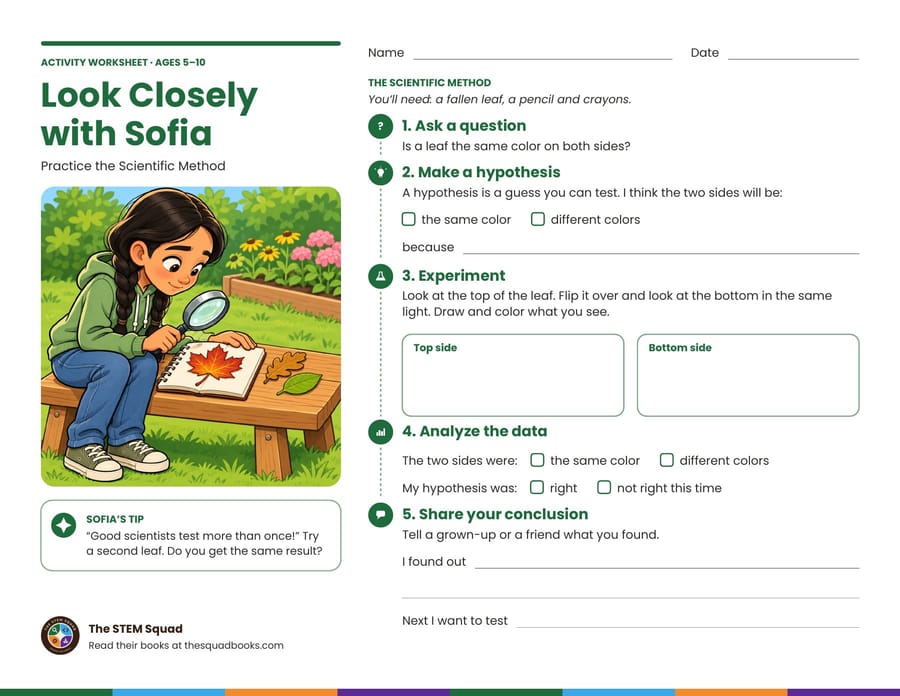 Download PDF: Look Closely with Sofia
Method worksheet
Look Closely with Sofia
Is a leaf the same color on both sides? Look, guess, then check.
-
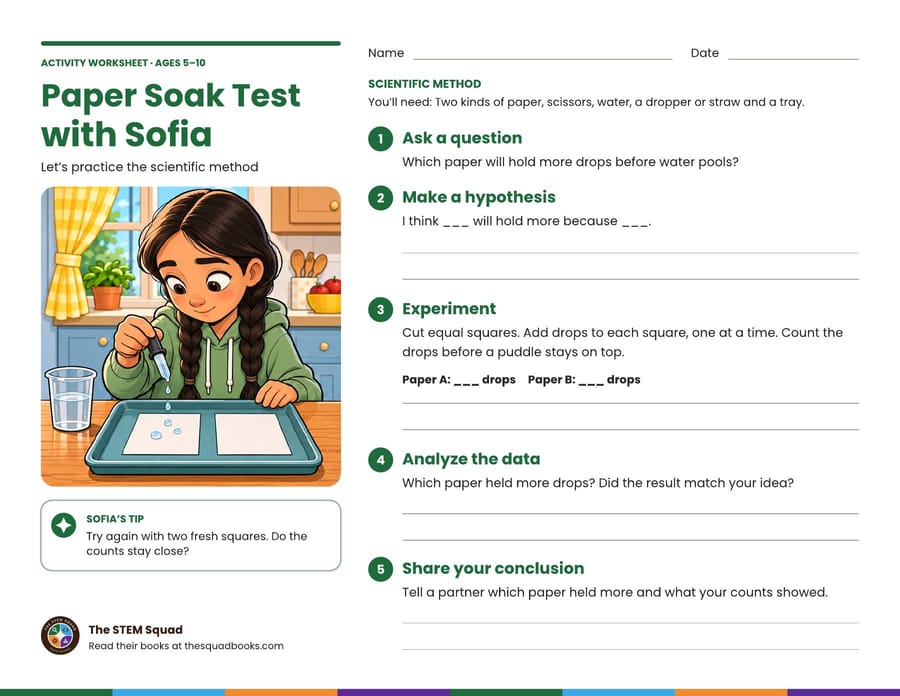 Download PDF: Paper Soak Test
Activity sheet
Paper Soak Test
Which paper holds more drops before the water pools?
-
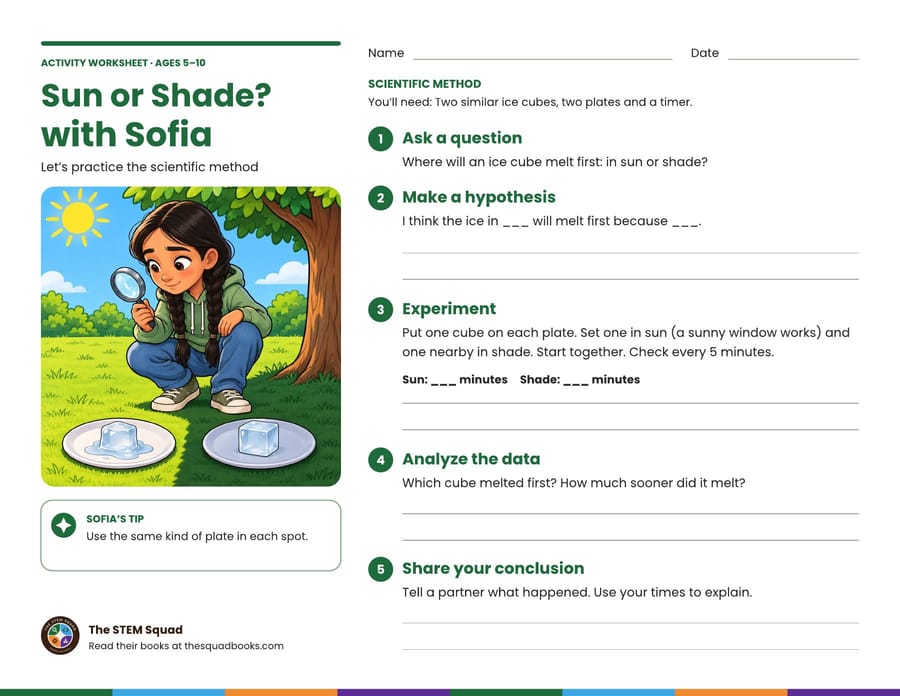 Download PDF: Sun or Shade?
Activity sheet
Sun or Shade?
Where does an ice cube melt first: in the sun or in the shade?
-
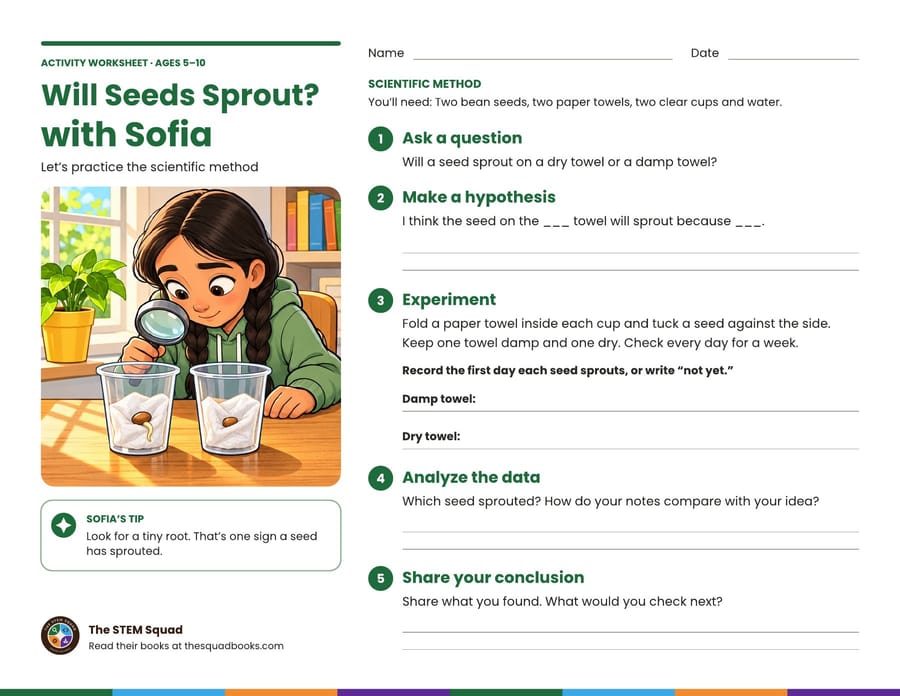 Download PDF: Will Seeds Sprout?
Activity sheet
Will Seeds Sprout?
Will a bean seed sprout on a dry towel or a damp one?
-
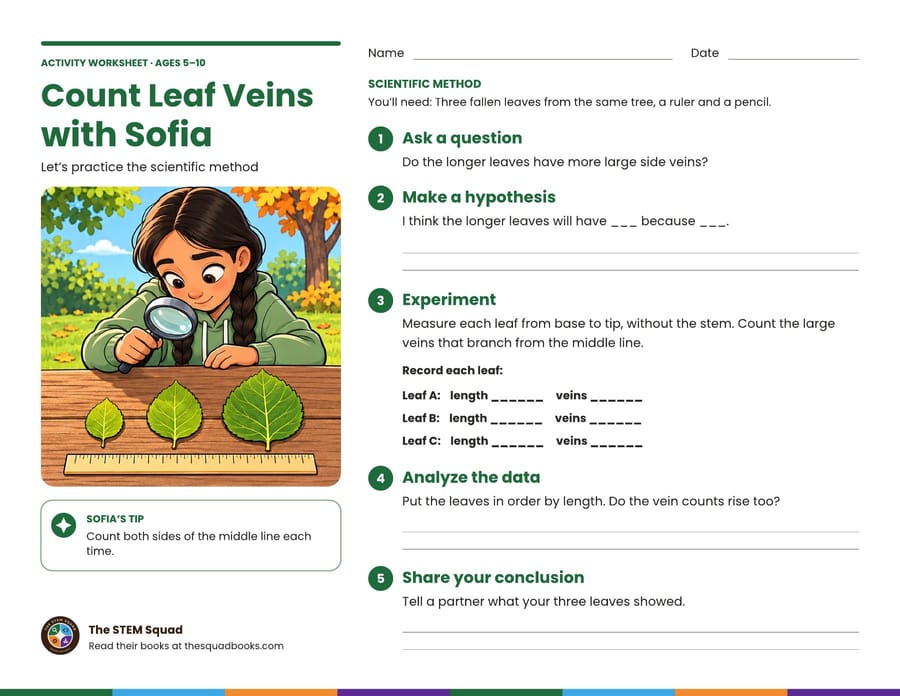 Download PDF: Count Leaf Veins
Activity sheet
Count Leaf Veins
Do longer leaves have more large side veins?


-
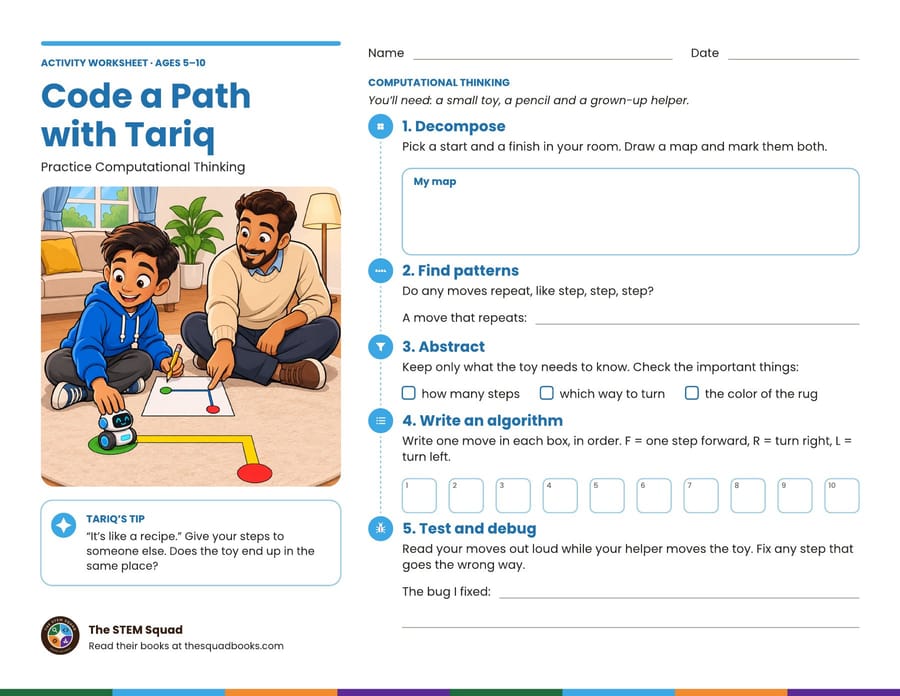 Download PDF: Code a Path with Tariq
Method worksheet
Code a Path with Tariq
Write step-by-step moves that guide a toy across the room.
-
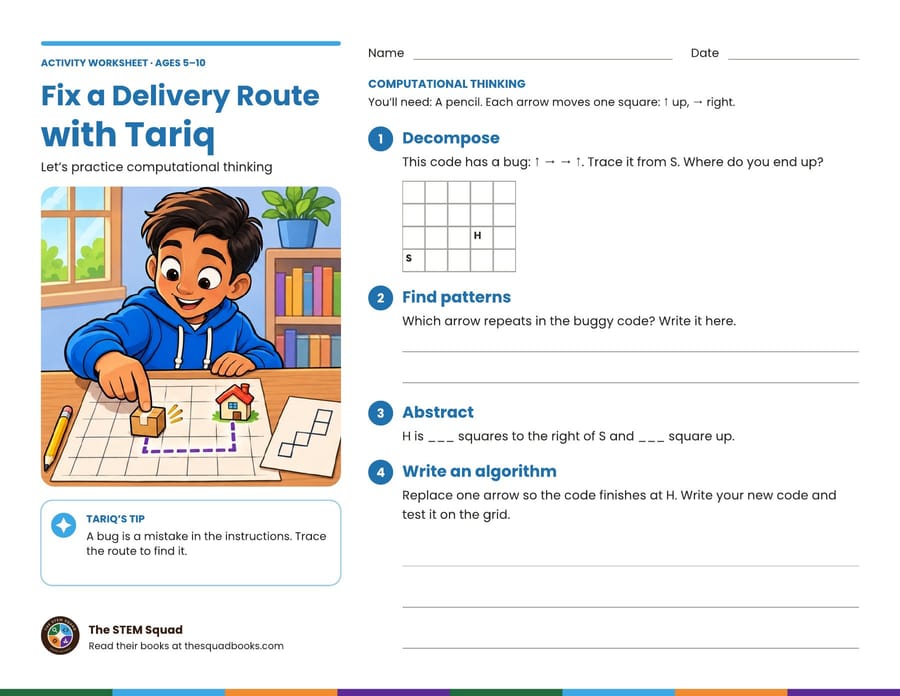 Download PDF: Fix a Delivery Route
Activity sheet
Fix a Delivery Route
Trace a short arrow code, find the bug and fix it.
-
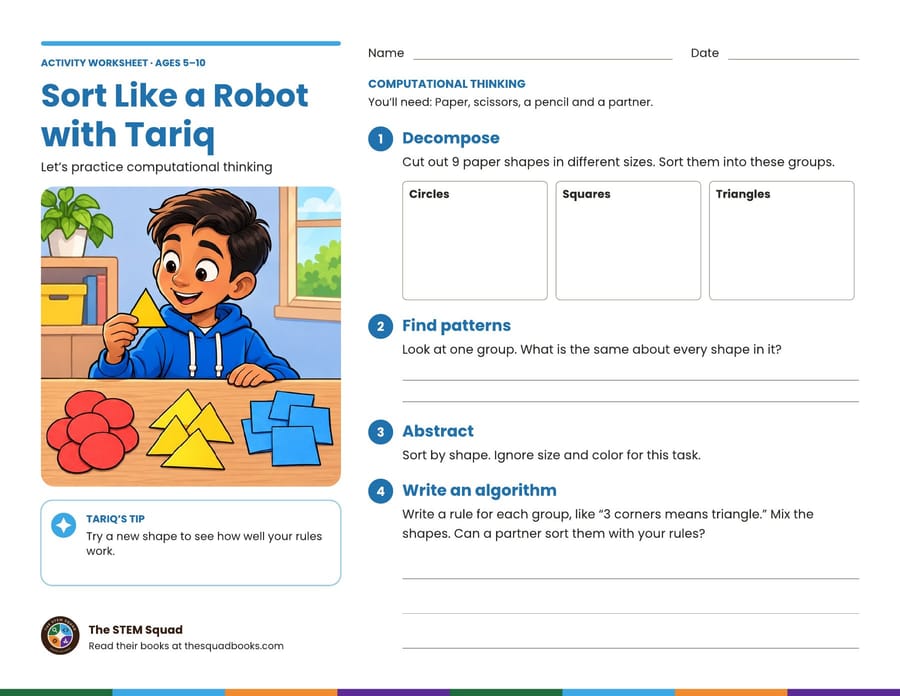 Download PDF: Sort Like a Robot
Activity sheet
Sort Like a Robot
Cut out shapes and write sorting rules a partner can follow.
-
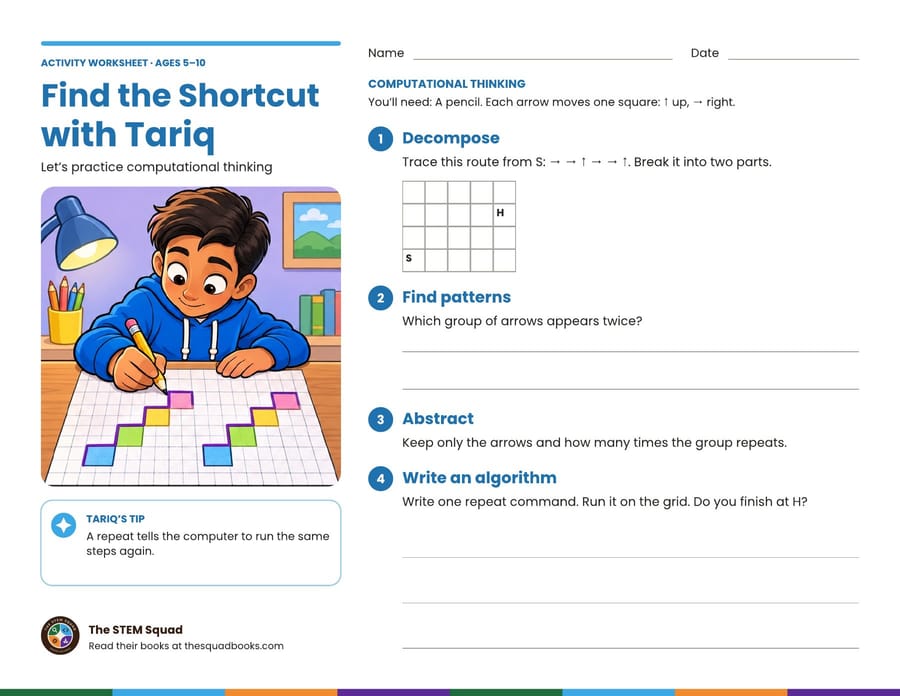 Download PDF: Find the Shortcut
Activity sheet
Find the Shortcut
Spot the repeating moves and shrink a route into one repeat.
-
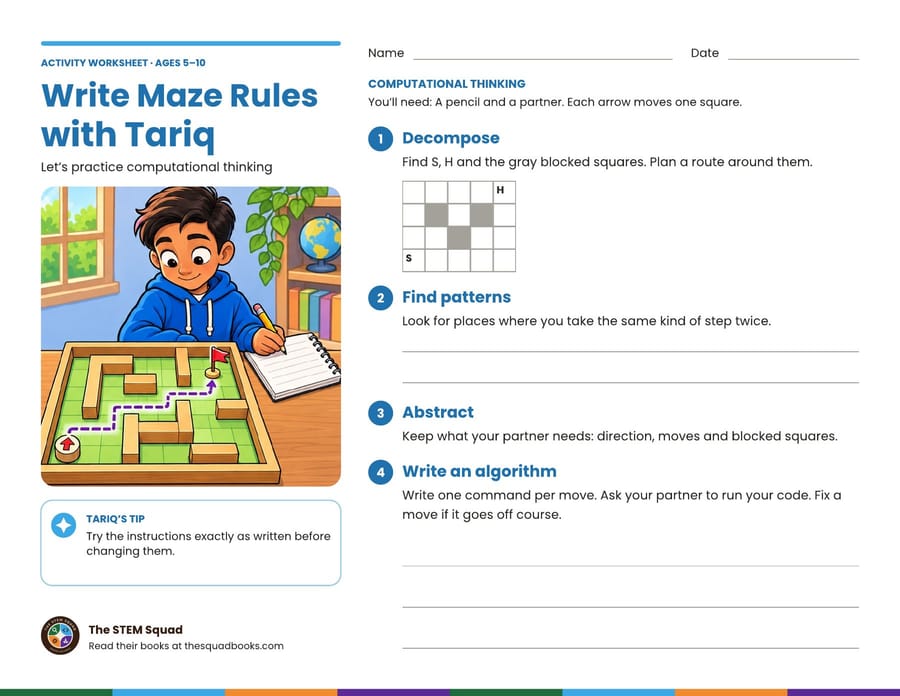 Download PDF: Write Maze Rules
Activity sheet
Write Maze Rules
Write code that guides a partner around blocked squares.


-
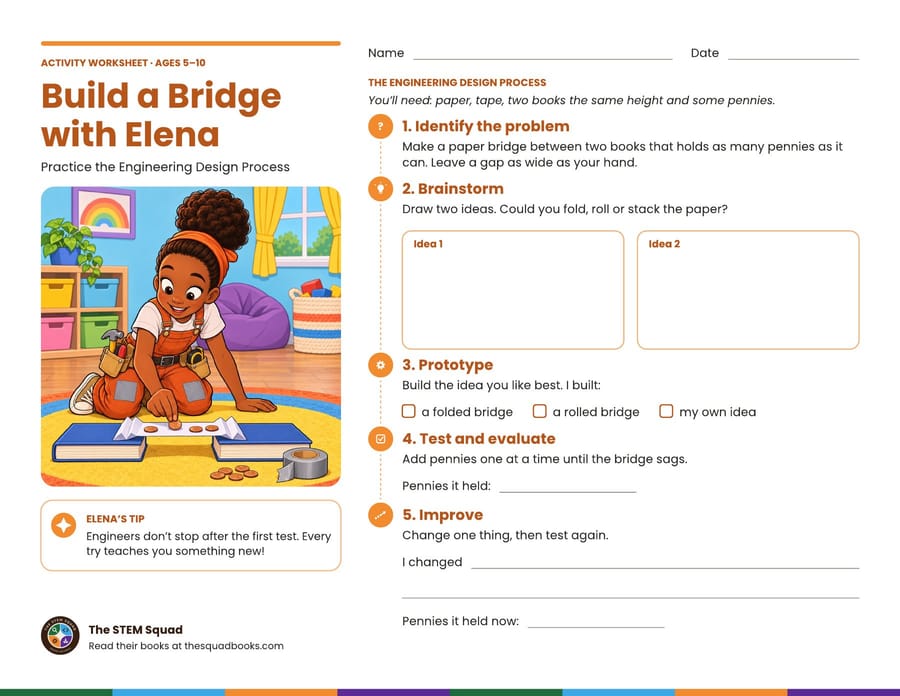 Download PDF: Build a Bridge with Elena
Method worksheet
Build a Bridge with Elena
Make a paper bridge that holds as many pennies as it can.
-
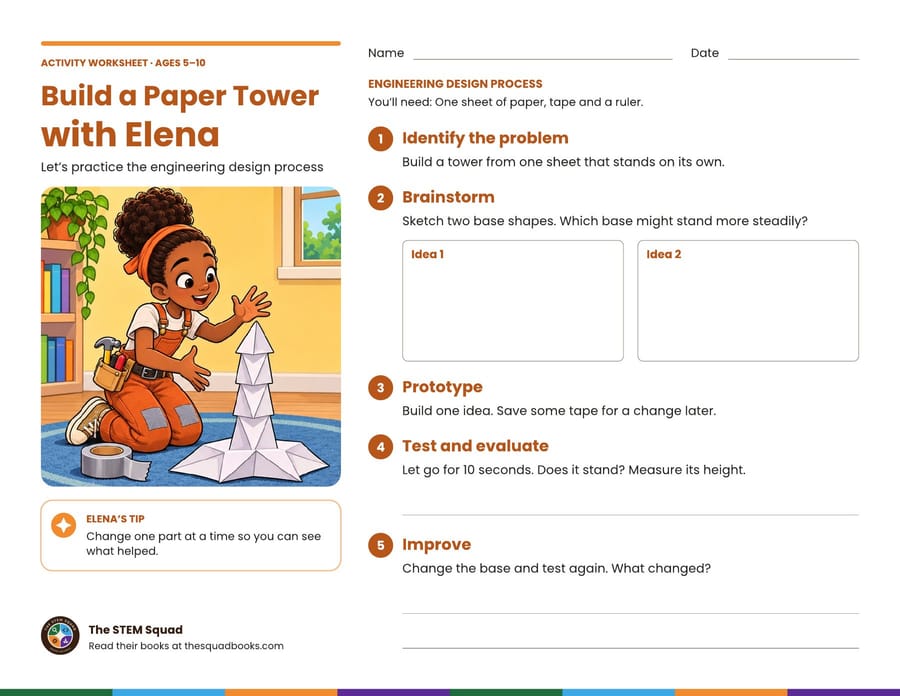 Download PDF: Build a Paper Tower
Activity sheet
Build a Paper Tower
Build a tower from one sheet of paper that stands on its own.
-
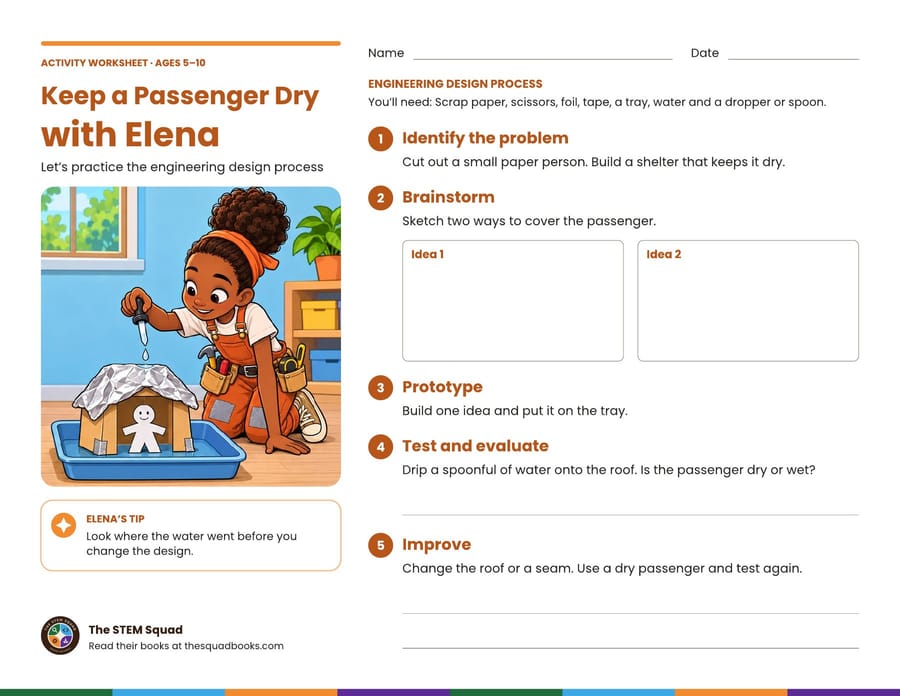 Download PDF: Keep a Passenger Dry
Activity sheet
Keep a Passenger Dry
Build a shelter that keeps a little paper person dry.
-
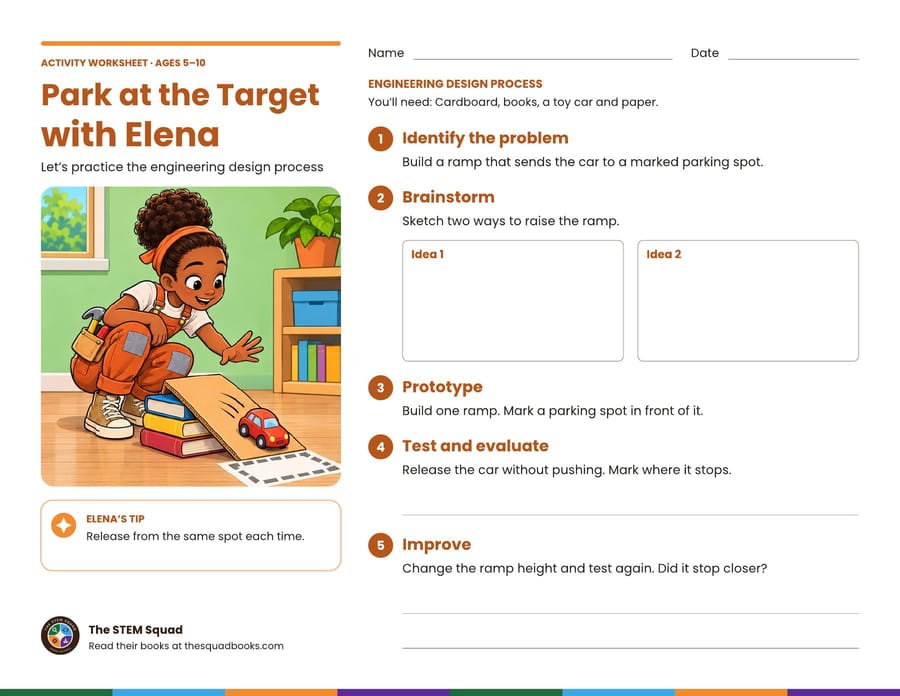 Download PDF: Park at the Target
Activity sheet
Park at the Target
Build a ramp that rolls a toy car into a parking spot.
-
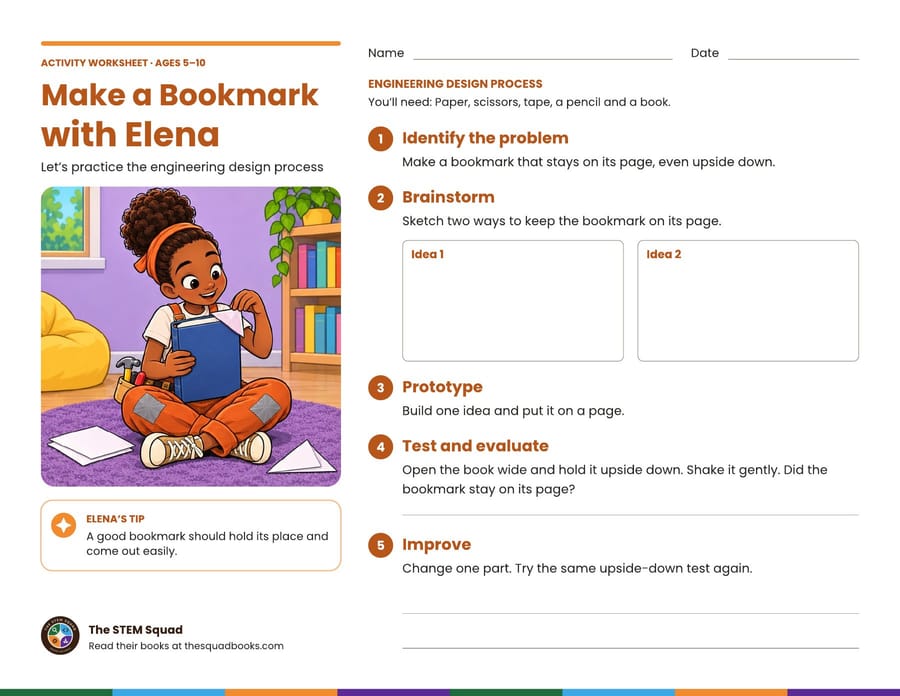 Download PDF: Make a Bookmark
Activity sheet
Make a Bookmark
Make a bookmark that stays on its page, even upside down.


-
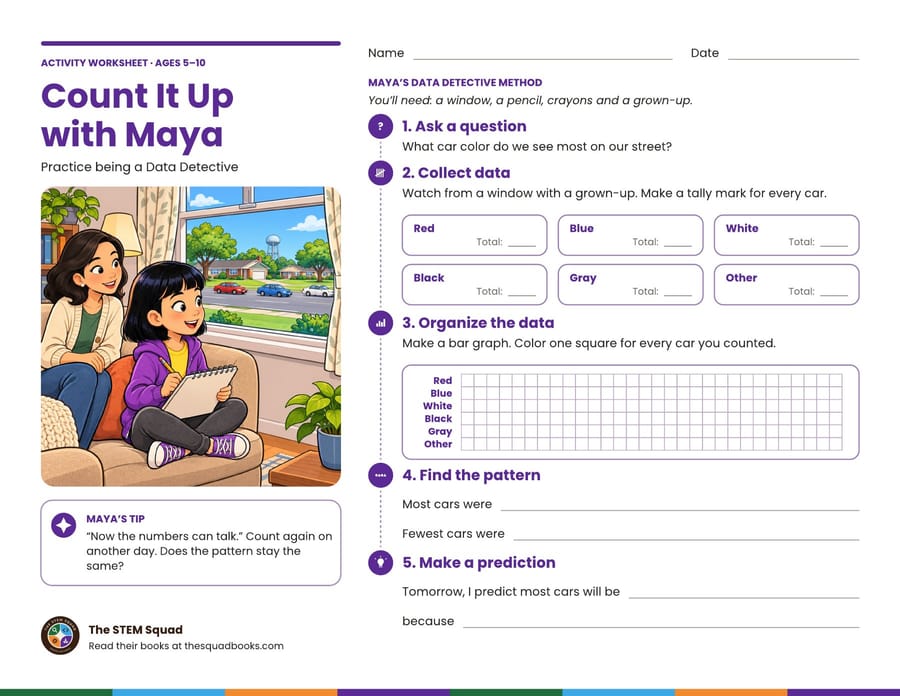 Download PDF: Count It Up with Maya
Method worksheet
Count It Up with Maya
Which car color do we see most on our street?
-
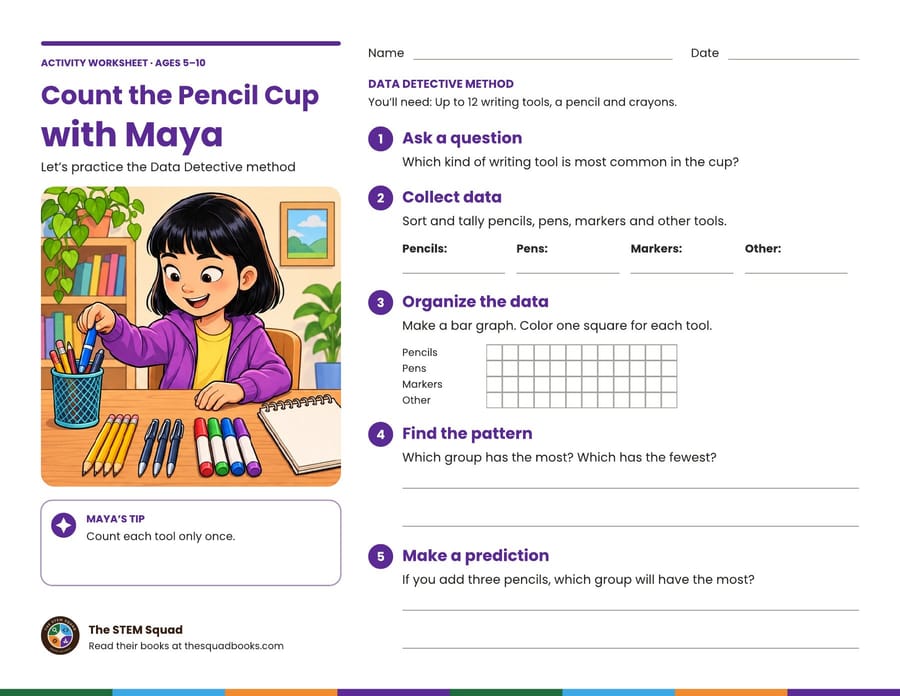 Download PDF: Count the Pencil Cup
Activity sheet
Count the Pencil Cup
Which kind of writing tool is most common in the cup?
-
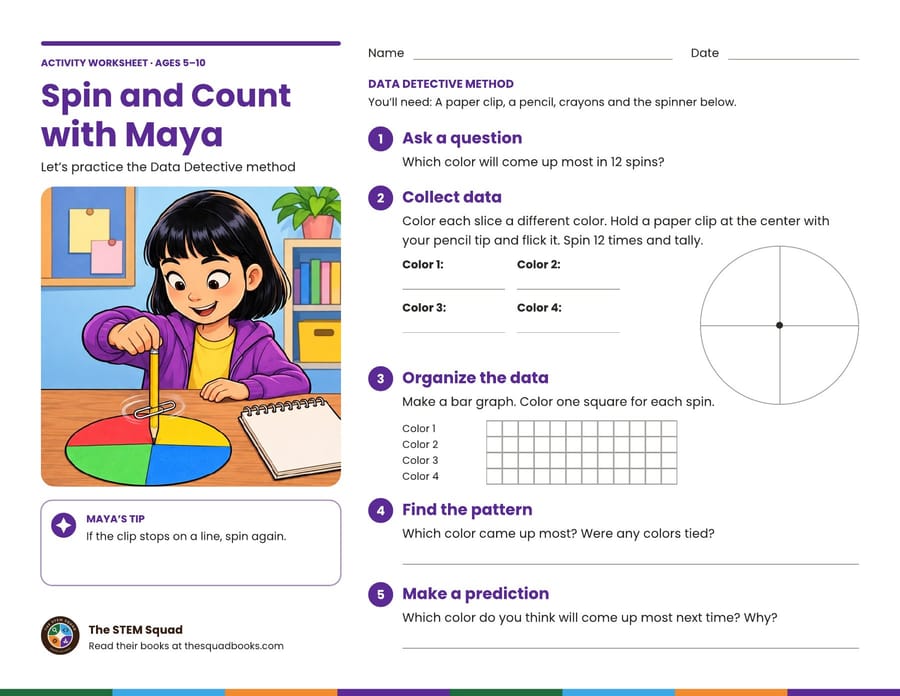 Download PDF: Spin and Count
Activity sheet
Spin and Count
Which color comes up most in 12 spins of a paper clip spinner?
-
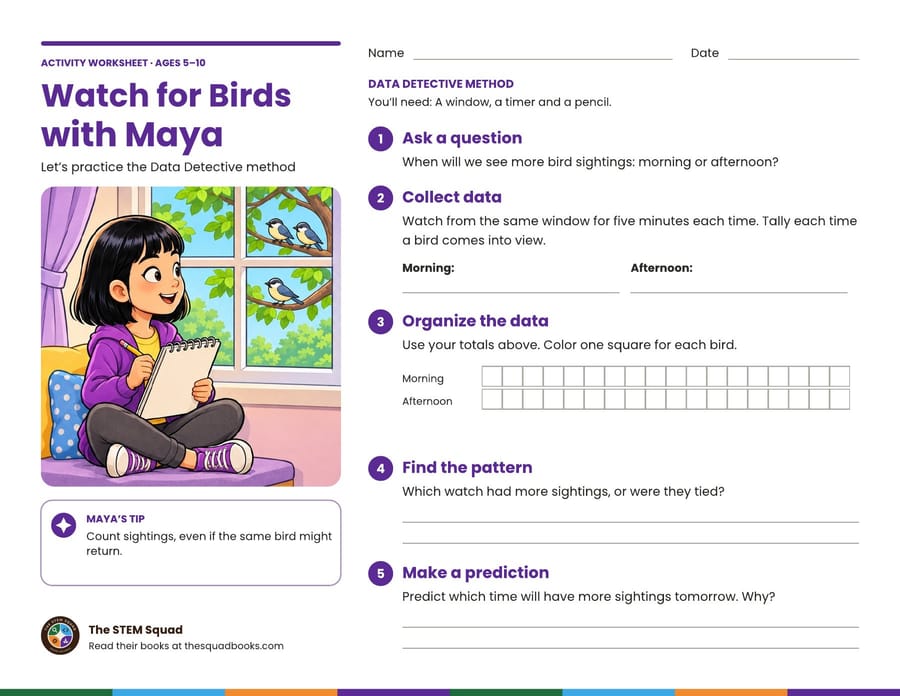 Download PDF: Watch for Birds
Activity sheet
Watch for Birds
Do we see more birds in the morning or the afternoon?
-
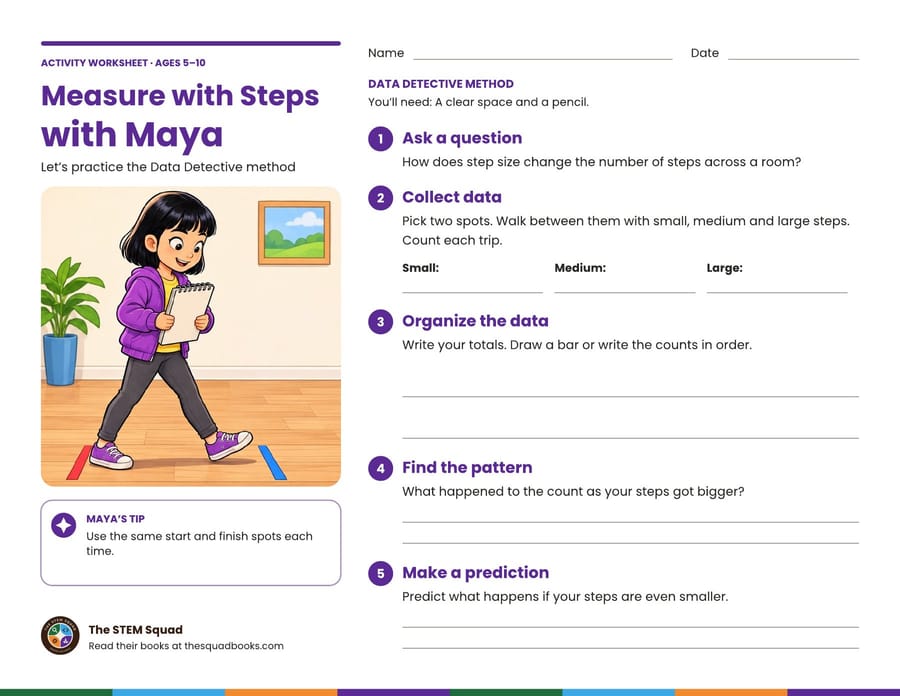 Download PDF: Measure with Steps
Activity sheet
Measure with Steps
How does step size change the number of steps across a room?


Quick answers
What ages are The STEM Squad books for?
Ages 5 to 10. Younger children can enjoy the stories read aloud, and older children can read them on their own.
What order should the books be read in?
The stories are best read in order, starting with Book One: Sofia's Discovery, Tariq's Code, Elena Builds, Maya's Patterns, The Water Crisis, The Energy Blackout, Building for Everyone, The Food Waste Crisis, The Recess Alert and The Big Solution.
Which books are out now?
Sofia's Discovery, Tariq's Code, Elena Builds, Maya's Patterns, The Water Crisis, The Energy Blackout, Building for Everyone, The Food Waste Crisis, The Recess Alert and The Big Solution are out now. Season One is ten books.
What format are the books, and where can I buy them?
The books are ebooks, sold on Amazon Kindle, Google Play Books and Apple Books. Print editions are planned.
Who writes and illustrates the books?
The stories are written by Rick Hollandsworth. The illustrations are made with AI image tools under Rick's art direction, and each one is chosen, refined and laid out by hand.
How to use the books
At home: read the story together, then try the book's home activity.
In class: each book follows one named method, so it works as a short introduction before a hands-on lesson.
Home activity
Sofia's Discovery
Go outside and observe your yard for 10 minutes like Sofia. What patterns do you notice? Sketch them!
Home activity
Tariq's Code
Can you find a loop in your day? Something that repeats, like brushing your teeth or feeding a pet? Write it like code: REPEAT EVERY MORNING: ...
Home activity
Elena Builds
Can you build a bridge that holds five toy cars using only popsicle sticks and tape? Use all five steps: Identify, Brainstorm, Prototype, Test & Evaluate, Improve. If it breaks, that's data!
Home activity
Maya's Patterns
Be a Data Detective! On a sunny day, push a stick into the ground. Every hour, put a rock at the tip of its shadow. What pattern do you see? Can you predict where the next rock will go?
Home activity
The Water Crisis
Be a Water Scientist! With an adult, build a bottle filter with gravel, sand, and charcoal. Pour in muddy water and compare before and after. Remember: clear does not mean clean, so never drink it! Then find a storm drain near your home. Where do you think the water goes?